By Shane Dempsey , ARC Mediation – Founding Partner
I read reading an article by Dispute Resolution expert and researcher Inès Khalifa about Trauma Informed Mediation & the Psychological Aftermath.
The discussion surrounding the article was fascinating and prompted me to reflection on how my attitude to trauma in mediation has shifted over the years; as I get older, more battered, more experienced & hopefully wise and more informed.
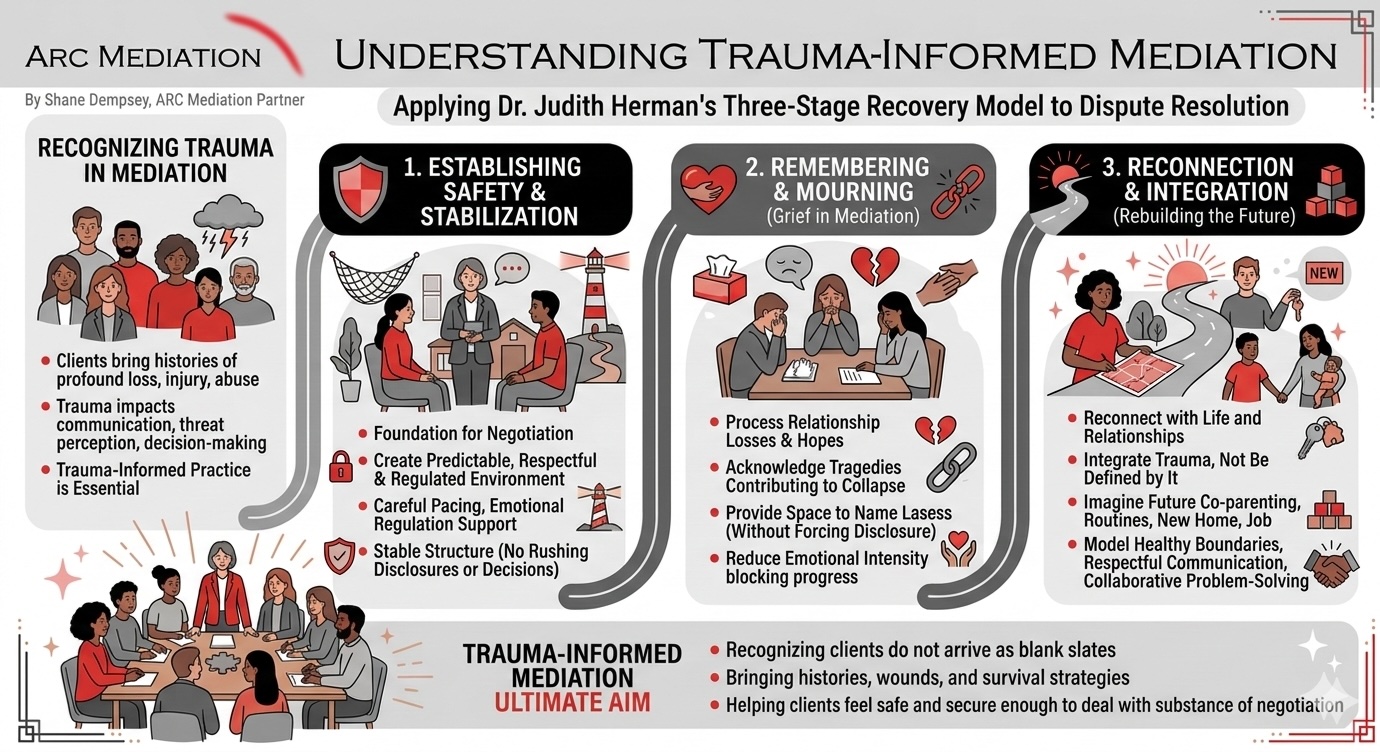
In mediation, we increasingly encounter clients whose relationship breakdown is intertwined with trauma; sometimes arising from relationship breakdown itself, but often rooted in profound losses such as the death of a child, a serious injury, unresolved impact from childhood abuse, or other life?altering events. Trauma shapes how people communicate, how they perceive threat, and how they make decisions. For this reason, trauma-informed practice is not an optional enhancement to mediation; it is essential.
In our work, we’ve drawn inspiration from Dr Judith Herman’s three?stage recovery model, which offers a humane and structured way of understanding the client’s journey through trauma.
The stages are Safety and Stabilisation, Remembrance and Mourning, and Reconnection and Integration
1. Establishing Safety
Before meaningful negotiation can occur, clients must be helped feel physically & emotionally safe. Herman emphasises that safety is the foundation for all subsequent work, and this is true in mediation. Creating a predictable, respectful & regulated environment allows clients to participate without becoming overwhelmed or re?traumatised. This may involve pacing the process carefully, supporting emotional regulation, and ensuring that clients feel supported by a stable structure rather than pushed into disclosure or decision?making before they are ready.
2. Remembering and Mourning
Relationship breakdown often brings layers of grief. Grief for the relationship, for lost hopes, and sometimes for traumatic events that contributed to its collapse. Herman describes this stage as a period of reconstruction and mourning, where clients make sense of what has happened and acknowledge the losses they carry. In mediation, we witness how unprocessed grief can fuel conflict or silence. Providing space for clients to name these losses, without rushing them or forcing disclosure, can help reduce the emotional intensity that otherwise blocks progress.
3. Reconnection and Integration
The final stage involves helping clients reconnect with their lives and relationships in a way that integrates their trauma rather than being defined by it. In mediation, this often means supporting clients to imagine a future beyond the crisis; co?parenting arrangements, new routines, new accommodation & employment, or simply a way of interacting that feels safe and sustainable.
Herman notes that this stage is about rebuilding trust, autonomy, and a sense of self that is not dominated by trauma. Mediation can play a powerful role here by modelling healthy boundaries, respectful communication, and collaborative problem-solving.
Trauma-informed mediation is ultimately about recognising that people do not arrive at the table as blank slates. They bring histories, wounds, and survival strategies. It’s all about helping clients to feel safe & secure enough to deal with the substance of negotiation.